THEATER: artsinternational
DRUNKEN WITH WHAT
A TARGET MARGIN THEATER PRODUCTION
Directed
by
David Herskovits
Reviewed by BINA SHARIF
DRUNKEN WITH WHAT is a study of Mourning Becomes Electra by O'Neill which is
based on the reworking of themes from Greek Tragedy, ORESTEIA By Aeschylus.
In the ancient times the word tragedy was dedicated and blamed on fate. "Tragedy was considered a flaw in nature and thus its result was predetermined by Kismet/fate. But in modern times the word, "tragedy" has a different take on things and can be analyzed more as a motivational psychological theory. But in O'Neill's Mourning Become Electra on which Drunken With What is based is for sure
a Greek Myth in which fate asserts a major blow.
Drunken With What as Mourning Becomes Electra has characters parallel from Greek play, Oresteia.
General Ezra, the father--Agamemnon
Christine, the mother--Clytemnestra
Orin, the son--Orestes
Lavinia, the daughter--Electra
And what a brave undertaking by David Herskovits to reintroduce the epic trilogy to the new audience who might not have read or seen O'Neill's Opus.
Though Drunken With What is compressed and many scenes have been taken out of the original
play, it makes perfect sense in the telling of the story.
The play takes place in New England after the Civil War where Lavinia, the dutiful daughter is waiting for the return of her father, General Ezra. She is also in love with Captain Adam and is horrified to find out that her mother Christine, ( Brilliant Stephanie Weeks) is having an affair with him as well. Consumed with jealousy she confronts her mother leading to mad anger, adultery and murder. When the General comes home, Christine Poisons him and Lavinia and her brother who is also very fond of his mother, (Incest perhaps? ) Try to take revenge.
Revenge, a major theme of all Greek tragedy always wins but actually no one wins at the end.
Drunken With What is directed very well with no fuss on the set and props. A minimal setting forwards the story in a clear and coherent manner. Actors are all very good though I couldn't hear Lavinia, (Eunice Wong ) very clearly first but she became better eventually.
I also enjoyed Mary Neufeld as Seth, the narrator/gardner.
Overall it was a reaffirming experience of a great classic
BINA SHARIF
Editor/Publisher of a theater blog; artsinternational.blogspot.com
binashariff@gmail.com
binasharif@earthlink.net
www.facebook.com
Cell:212-260-6207
 ARTS INTERNATIONAL
Editor/Publisher, Bina Sharif
ARTS INTERNATIONAL covers THEATER, FILM, VISUAL ARTS, CUISINE, AND LITERATURE
Sunday, February 14, 2016

Tuesday, February 2, 2016
O, EARTH AT FOUNDRY THEATER
THEATER REVIEW
FOUNDRY THEATER Presents
O, EARTH
Written by Casey Llewellyn
Directed by Dustin Wills
At HERE Theater till Feb 20
REVIEWED by BINA SHARIF
O, EARTH is a Surrealistic riff on, Thornton Wilder's "Our Town."
The set has a little mountain of real dirt on one side and a solitary ladder on the other.
The floor of the whole stage is also covered with dusty dirt.
The lights are pretty haunting and ghostly.
We encounter a man with a shovel presumably, Wilder (Martin Moran) digging into the mound
looking for some lost object, (Time ) perhaps? The play tries to cover the time from 20th Century
to 21st Century and the cultural changes which took place in American life.
Then we encounters a stage manager (Donnetta Lavinia Grays) Avery funny black actress narrates for us the story of white folks in that town while she herself feels invisible moving the ladder from one side of the stage to the other.
There is also a love story taking place between Emily (Kristen Sieh) a young woman who is un-satisfied with her life in this town where according to her nothing is happening and nothing is there to hold onto. She has a boyfriend, George (Jess Barbagallo) who is a transgender and loves baseball as well as Emily. We also meet Simon Stimson, (Martin Moran) a closeted gay man who drinks a lot to find comfort in his loneliness.
All these characters are very familiar from the play, "Our Town" and then suddenly the play, O, Earth
changes into the present time where we are watching TV and Ellen DeGeneres (Moe Angelos) appears. Her wife Portia de Rossi (Emily Davis) is also there first in the background complaining to Ellen that she feels very lonely and then in her actual kitchen having wine with
Emily who by now must have left her isolated town as well as her transgender boyfriend George behind.
The play changes its course from this moment on and becomes more like a TV talk show where
the ghosts of Marsha P. Johnson (Julienne Brown) and Sylvia Rivera (Cecilia Gentili) EARLY TRANSGENDER ACTIVISTS appear and complain about not being properly represented at the moment. The play refers to the effect that the gay marriage being legal right now is not good enough
and other issues such as transgender should be paid more attention.
At this time the play scatters and becomes less engrossing and sounds like a political protest
and its dramatic tension withers but some of the earlier elements are very effective.
The set is fantastic, the lights are moody and haunting, the actors do a good job, I particularly
liked Emily Davis who played Portia de Rossi staring into the void and drinking.
Donnetta Lavinia Grays as the stage manager was also very effective.
Bina Sharif
artsinternational.blogspot.com
binashariff@gmail.com
www.facebook.com
Cell: 212-260-6207
Monday, January 25, 2016
THE GLORY OF THE WORLD
THEATER
BAM and Knight Blanc present
"THE GLORY OF THE WORLD"
By Charles Mee
Directed by Les Waters
At; BAM Harvey Theater
Reviewed
by
BINA SHARIF
"The Glory of The World" The play is about Thomas Merton, the Kentucky based Roman Catholic
monk. It is staged as a party, a centennial celebration in a very avant-garde style.
When the play begins we see a man, (Monk) played by Les Waters sitting completely still and silent
with his back towards the audience, (A stunning moment ) and his thoughts being projected onto stage. Merton was the author of the seven Storey Mountain and many other books and had a lot to say. His wisdom and philosophy had many questions such as, "What if nothing is sacred-and everything is?" "What makes a man?" 'What makes a saint?" Amazing sayings for food for thought.
Theater is supposed to be about action, at least thats what every one says and expects but for me that
moment of silence which was actually quite long had incredible movement of thought and calm and peace and drama in it. A perfect beginning, what else a monk should be doing if not sitting silently
in a noiseless place and reflecting on his spirit and his being.
Then all of a sudden there was a real celebration in the form of a party. 17 men, most of them very handsome with incredible bodies come barging in a vast room which seems like the basement of a garage or a gym perhaps or a rented party room with a ping pong table and an inflatable air mattress.
They drink, they dance, they run around, one of them tries to get on that mattress un-successfully and then all of a sudden the party turns into a fight which gets intense by the minute and seems quite ominous at times. Two interesting thoughts enter my mind at that point.
Knowing Charles Mee's work which is extremely experimental, first I wondered if he is exposing the beauty of the monk's silent and quiet life of contemplation and contrasting it with the noisy, mundane, mind bogglingly busy world of the one's who are celebrating the monk's birthday?
Second thought which I struggled with was, what is better, the noise or the quiet? The peaceful
boring relaxation or a very hectic, exciting gathering which can also turn into violence of excess?
I couldn't actually decide what the writer and the director meant by this very long fight in the middle of the celebration for a secluded, catholic monk who must have avoided such gatherings.
But knowing Mee's style, he must have some kind of meaning which didn't come across so easily.
However the fight was choreographed brilliantly.
Then a bit more calm came into the play when all those men in party hats sat on little chairs in a row and expressed quotes by many scholars and writers such as George Bernard Shaw and Oscar Wilde about , "SOLITUDE" and "LONELINESS" Even Lady Gaga was quoted being lonely and sitting in a quiet room all alone by herself.
It was an interesting change from the fight edging towards violence.
I have to say that I enjoyed the show though I didn't understand the concept of the play. I wanted to learn more about Thomas Merton and how and why he chose seclusion, meditation and the silence.
Talking of silence, the last scene of the play is exactly the same as the opening of the play. A MAN,
sitting silently facing us this time with incredible control over his stillness, (A difficult job to sit still for an average actor but never for Les Waters) and again the words of wisdom being projected onto stage. I Liked that image of the silent poet digging into the depths of his spirituality far removed from this busy and noisy world. Theater in its stillness can also be very moving.
Bina Sharif
For, " artsinternational"
artsinternational.blogspot.com
binashariff@gmail.com
www.face book.com
Cell:212-260-6207
Monday, December 21, 2015
''ANTIGONA" REVIEW
SOLEDAD BARRIO AND
NOCHE FLAMENCA
Presents
"ANTIGONA"
Adapted& Directed by Martin Santangelo
Choreography by Soledad Barrio
At West Park Presbyterian Church, (165 W 86th Street ) Till January 23rd
REVIEWED
BY
BINA SHARIF
Sophocles wrote a fatal tragedy in which the fate of the characters is determined by destiny.
In,"ANTIGONA" the flamenco and the story of Antigone combined with the most passionate
music, movement, lament, the soulful chants and Soledad Barrio's dance which is un-matched
by any dancer living or dead gives us chills and make our souls so touched with the desire of changing that destiny and make Soledad Barrio's Antigona live for ever and ever and dance for ever and ever....
but alas the story's tragic end is controlled by fate and who are we to change that fate but experiencing this, AMAZING, FANTASTIC, EXTREMELY POWERFUL, PASSIONATE
PRODUCTION, THE FATE OF DANCE AND TRAGEDY IS CHANGED FOR ME FOREVER.
NO ONE IN MY VIEW CAN EVER DANCE BETTER THAN SOLEDAD BARRIO AND NO ONE CAN SING, LAMENT AND PLAY MUSIC BETTER THAN THE MUSICIANS IN THIS
AMAZINGLY MOVING PRODUCTION OF, "ANTGONA."
I saw this play a few days ago and I still imagine myself sitting in that ancient church and shivering with emotions stirred by such high talent and power of that blazing talent and craft that I can't stop
shivering still. My friend who accompanied me is an Australian living in London who is a passionate theater goer and he feels exactly the same. He said that it was the best experience of his stay in NY
and he has never seen any dancer better than Soledad Barrio in the whole world.
(Believe me, he did go to Broadway a few times)
The story of Antigone by Sophocles is of family, power, politics and of never ending blood shed.
Its amazing how relevant the story seems in today's politics and wars and un-rest.
Antigona is based on that very story of myths about the children of Oedipus, the king of Thebes who kills his father and marries his own mother.
After the death of Oedipus, his sons Polyneices and Eteocles, fight with each other for power grabs and are both killed. Creon, their uncle becomes the king of Thebes and refuse to bury the corpse of Polyneices whom he considers a traitor and buries the other brother with honors.
Antigone defies the king and buries her brother. The brother's corpse is un-buried again by the king's guards and Antigone buries him again, is caught this time and ordered to be buried alive in a cave.
Creon's son who is in love with Antigone pleads with the king to spare her life but the tragedy is waiting in the wings and eventually the house of Creon is destroyed.
Tiresis, a blind prophet, ( "SUPERB"Pepe El Bocadillo ) pleads with the king and reminds him of the wrath of gods for murdering his own flesh and blood but Creon pays no attention and then its too late for him too.
I have always loved this story not because I am fatalistic but the power of the story and its relevance with the nature of man and his search for power and glory and its eventual elements of destruction
reminds me of the power of gods and the myth of destiny which warns me to be a kinder and caring person and my utmost joy is always not wanting a throne but having a great experience when I am watching the art in its sublime form and "ANTIGONA" was that for me. "SUBLIME"
Every one in this haunting production was great but Tieresis, the blind prophet played by Pepe El Bocadilio and, Juan Ogalla, (Haemon) were superb.
And Soledad Barrio, I wish I can watch her and watch her and watch her and I won't want anything more in my artistic search and its pleasures.
Also a great job by Martin Santangelo, the director, artistic director and the lucky husband of Soledad Barrio
Reviewed by Bina Sharif for
artsinternational
artsinternational.blogspot.com
binashariff@gmail.com
Cell: 212-260-6207
Facebook.com
Saturday, April 25, 2015
JOHN PIZZARELLI SINGS AT CAFE CARLYLE
REVIEW
BY
BINA SHARIF
In one of the most elegant room with the most charming original murals created by French artist
Marcel Verte's, where melodiously colored paintings float up in the air like wingless singing birds
we, (The fortunate ones ) sip wine slowly and listen to Bossa nova love songs from the album,"Amoroso.' by the Brazilian singer/guitarist Joao Gilberto.
The scene for love, extreme joy and a nostalgic feeling of leisure & relaxation sets in.
John Pizzarelli is joined by Daniel Jobim who is the son of guitarist Paulo Jobim and grandson of
composer Antonio Carlos Jobim. They both sang bossa nova classics by Jobim's grandfather softly, so very softly as if they were whispering in the ears of their beloveds some ancient secrets of love not to be heard by an other soul.
How wonderfully comforting and melodious that music felt unlike the screams and high pitched noise of modern singers.
I loved all the songs especially, (but of course) "Girl from Ipanema." "Quiet nights of quiet stars."
"Two kites." ' S wonderful (George Gershwin, Ira Gershwin) "Waters of March" and, "How Insensitive."
There was such a spirit of joy in both John Pizzarelli and Daniel Jobim's voices when they recreated the superb mood of bossa nova love songs and Daniel Jobim was brimming with pride every time his grand father, Antonio Carlos Jobim's name was mentioned.
I also throughly enjoyed the ballads such as, "Change partners, " and "I Remember" from the I967 Album, "Francis Albert Sinatra and Antonio Carlos
Jobim."
There were lots of lovely anecdotes by John Pizzarelli throughout the evening, jokes about the effectiveness of Viagra like effect of this particular music and how Antonio Carlos got a phone call from Sinatra at a bar in Brazil.
Rest of the band, Helio Alves-Piano, Martin Pizzarelli-Bass,Duduka Dafonseca-drums were all incredible. Daniel Jobim was at Piano as well.
The original song, 'Soares Samba" by John Pizzarelli was thrilling as he played around with his guitar.
Mr. Pizzarelli is the recipient of Ella Fitzgerald award established in 1999 for the 20th anniversary of the Montreal Jazz Festival and has been featured over 40 albums as a sideman, accompanying greats as
Paul McCartney and many others.
I will go back to listen to their enchantingly beautiful music any time any where but Cafe Carlyle
makes it even more special and elegant. The atmosphere of this grand room is perfect for Mr. Pizzarelli and Daniel Jobim and the superb band.
I Still feel I am there and they are so very exotically whispering-whispering love songs to me, only for me.
artsinternational.blogspot.com
binashariff@gmail.com
www.facebook.com
Cell:212-260-6207
Thursday, February 19, 2015
THEATER REVIEW
BY
BINA SHARIF
DIJLA WAL. FURAT: BETWEEN THE TIGRIS AND THE EUPHRATES
BY
MAURICE DECAUL (US Marine Corps Veteran )
DIRECTED
BY
ALEX MALLORY, Part of POETIC LICENSE 2015; subconscious
AT THE WILD PROJECT: 195 E.3rd Street.
The play takes place in 2003: before, during and after the fall of Baghdad. (Statue of Saddam Hussein also falls with the great sound effects of thousands of people rejoicing ) One would wish to believe that the country, Iraq and its people and the soldiers by now will also rejoice because the job is accomplished and the victory achieved and a celebration due.
But wait, there are terrible and tragic surprises awaiting the people involved. There are four US Marines, four Iraqis and one reporter (French ) representing the thousands upon thousands of soldiers and Iraqis and the horrendous consequences as a result of this illegal
war, (started on the false assumption of the presence of weapons of mass destruction ) which were never there but the towns and cities and its inhabitants all turned into death camps, ghosts, burning bodies and un-imaginable destruction.
On a sand colored empty stage the Marines and Iraqis struggle and fight for their lives.
Their trauma and emotional devastation is absolutely hard to watch. In the very beginning of the play an errant mortar round kills a child, (A girl named Amina ) and his father begs her burial but the Marines don't allow it. They themselves are stricken with fear of some ominous tragedy befalling them.
Its just the beginning and the phantoms will haunt the living and the dead for the rest of times to come.
Then Baghdad burns and the loss of life, the soldiers deaths and their emotional devastation and the destruction of a country will have wounds so deep and trauma so heavy and the price every one will pay, so tremendous.
The brilliance of the author, Maurice Decaul is that he has made all his characters human and we feel their pain, loss and humanity throughout. We never hate the Marines for being the enemy because
their loss is also as huge as the Iraqis and it is even more Ironic and sad to watch because they want to go home to their families and their wives and to a normal life but still we feel so much more for the innocent iraqis and their tragedy brought upon them by a foreign power under a false premise.
Most of the acting is excellent and many scenes are very moving but the scenes between Labib and Marid played by, (Ankur Rathee and Fahim Hamid ) are totally hunting, living and the ghost of the dead never leaving each other alone.
And in another scene when Ortega, (Nabil Vinas ) is saved by his comrade Ali who gets killed himself and Ortega gets badly injured, (his wife back home waiting to deliver his baby ) is also extremely moving and painful to watch.
The production is brilliantly directed by Alex Mallory.
The sound design by Jaime A Diaz is astounding. The lighting design by Derek Miller is also very effective.
This kind of a war play is very hard to stage and realize with such a small cast but every one involved has done a great job and the play is very moving and evokes many feelings.
A very Important play for every one to see.
BY
BINA SHARIF
DIJLA WAL. FURAT: BETWEEN THE TIGRIS AND THE EUPHRATES
BY
MAURICE DECAUL (US Marine Corps Veteran )
DIRECTED
BY
ALEX MALLORY, Part of POETIC LICENSE 2015; subconscious
AT THE WILD PROJECT: 195 E.3rd Street.
The play takes place in 2003: before, during and after the fall of Baghdad. (Statue of Saddam Hussein also falls with the great sound effects of thousands of people rejoicing ) One would wish to believe that the country, Iraq and its people and the soldiers by now will also rejoice because the job is accomplished and the victory achieved and a celebration due.
But wait, there are terrible and tragic surprises awaiting the people involved. There are four US Marines, four Iraqis and one reporter (French ) representing the thousands upon thousands of soldiers and Iraqis and the horrendous consequences as a result of this illegal
war, (started on the false assumption of the presence of weapons of mass destruction ) which were never there but the towns and cities and its inhabitants all turned into death camps, ghosts, burning bodies and un-imaginable destruction.
On a sand colored empty stage the Marines and Iraqis struggle and fight for their lives.
Their trauma and emotional devastation is absolutely hard to watch. In the very beginning of the play an errant mortar round kills a child, (A girl named Amina ) and his father begs her burial but the Marines don't allow it. They themselves are stricken with fear of some ominous tragedy befalling them.
Its just the beginning and the phantoms will haunt the living and the dead for the rest of times to come.
Then Baghdad burns and the loss of life, the soldiers deaths and their emotional devastation and the destruction of a country will have wounds so deep and trauma so heavy and the price every one will pay, so tremendous.
The brilliance of the author, Maurice Decaul is that he has made all his characters human and we feel their pain, loss and humanity throughout. We never hate the Marines for being the enemy because
their loss is also as huge as the Iraqis and it is even more Ironic and sad to watch because they want to go home to their families and their wives and to a normal life but still we feel so much more for the innocent iraqis and their tragedy brought upon them by a foreign power under a false premise.
Most of the acting is excellent and many scenes are very moving but the scenes between Labib and Marid played by, (Ankur Rathee and Fahim Hamid ) are totally hunting, living and the ghost of the dead never leaving each other alone.
And in another scene when Ortega, (Nabil Vinas ) is saved by his comrade Ali who gets killed himself and Ortega gets badly injured, (his wife back home waiting to deliver his baby ) is also extremely moving and painful to watch.
The production is brilliantly directed by Alex Mallory.
The sound design by Jaime A Diaz is astounding. The lighting design by Derek Miller is also very effective.
This kind of a war play is very hard to stage and realize with such a small cast but every one involved has done a great job and the play is very moving and evokes many feelings.
A very Important play for every one to see.
Wednesday, February 4, 2015
“V.S. Gaitonde: Painting as Process, Painting as Life,” at the Guggenheim Museum, until February 11, 2015
“V.S. Gaitonde: Painting as Process, Painting as Life,” at the Guggenheim Museum, until February 11, 2015
REVIEW OF THE SHOW BY Poonam Srivastava
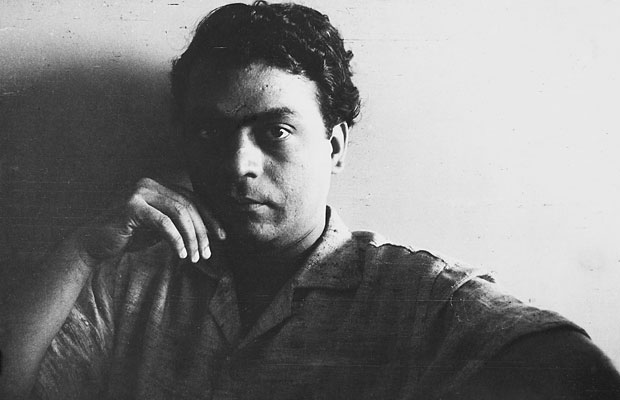
“I work as an individual. I do not have a scientific point of view. It is mostly my total experience of life [and] nature that comes through me, that is manifested on canvas. For me, every painting I do is a miracle … It is my sincere belief in life, truth, God, whatever it is, that prompts me to paint.”1 Quoted in Polyphonic Modernisms and Gaitonde’s Interiorized Worldview by Sandhini Poddar. In: VS Gaitonde: Painting as Process, Painting as Life, exhibition catalogue, published by Solomon R Guggenheim Museum and Prestel Verlag, New York, 2014, pages 27-28.
I was fortunate to witness the Vasudeo Santu Gaitonde, VSG, show, “V.S. Gaitonde: Painting as Process, Painting as Life,” at the Guggenheim Museum, October 24, 2014–February 11, 2015. The 45 paintings and drawings in oil on canvas and ink on paper, span the years 1952 to 1998. The show of VSG’s works, left me centered and moved. His is the rare talent that opens hearts, minds, and souls simultaneously. The show touched me both as a person with great interest in art, but also as person with great interest and affinity for Zen Buhddism. I was moved as a South Asian woman, and also on a deeply personal non-nationalistic/historic level. VSG’s work reflected his life, 1924 to 2001 and brought to focus the recently discarded twentieth century with all its twists and contradictions; being modern and global while embodying ancient truths; the East - West / North - South dichotomy that was brought to light by the works of such scholars as Gayatri Chakravorty Spivak and Edward Said. I am grateful that the Guggenheim for bringing his works to the attention of a greater public, and to my attention. Quite frankly the exhibit left me wanting more. I not only wanted to see more of V. S. Gaitonde's work, I wanted to know the man.
I agree with the New York Times in their January 1, 2015 article about VSG's work: " It is by a 20th-century Indian modernist who looked westward, eastward, homeward and inward to create an intensely personalized version of transculturalism, one that has given him mythic stature in his own country and pushed him to the top of the auction charts." Charts and
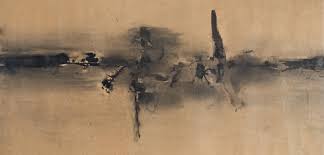
auction prices aside, the work I saw is the work of a true artist, one who transcends not only his geography but his historic moment to express the personal that is also the universal truth of life. His large canvases are monochromatic. There is a simplicity to them yet also a complexity. At first glance they are monochromatic studies of color. This draws you in and then you realize the world of detail that you have dropped into. The paintings are landscapes and portraits. For me they were uniquely Indian as well. The red one for example was an immediate connect to the myths of Kali and Durga and the female principle of the divine. There was another large oil on canvas that had me literally tasting curry and smelling cardamon. Yet as a western viewer I saw clearly Rothko, Klee and others, even as I realized VSG was simply Gaitonde.
In the earlier work, before 1970 or so, one sees more clearly the classical Western approach to modernism. Even a cursory google search of VSG's life and art reveals him as a hard working, spot light shunning, man who painted in a one room apartment in Delhi that also functioned as his studio. He never married and never had children. He worked in the community of artists and can be seen with his fellow painter chums, yet still worked outside of them. He reminds me of Henri Michaux that way -- with the Surrealists but not of them. VSG was a singular, rather solitary painter, well known as a member of the Bombay school of painting, not reflecting them but from within that bathwater marking his own strokes of genius. This then is what he offers.
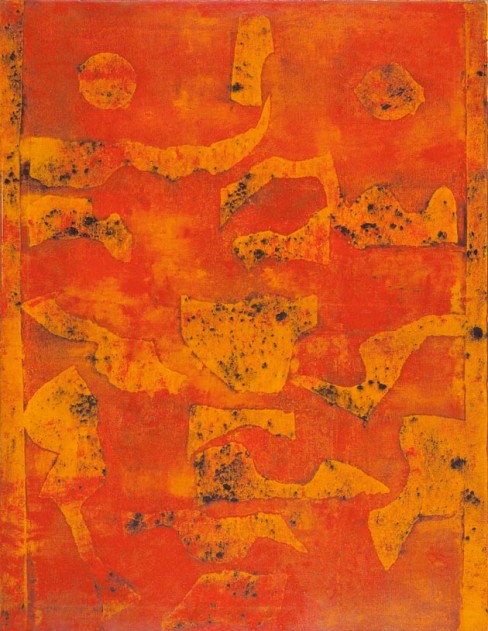
Within the forty five pieces I recalled Moghul minatures, hindu temple art, flashed back to my visit to the cave murals of Ajanta, north of the city of Aurangabad, recalled Jain painting, and also the artists Klee, Rothko and many more. His oils include calligraphy from the written Indus Valley and Harrapan languages as well as compositions influenced by the Hill Korwa Tribe now extant as well .
Here is an artist who cast a wide net and then spoke in his own breath creating technique and producing works that put the words such as derivative, global, Western, Eastern, even modern to a special light. During a 1962 show at MOMA he said: my painting “was done on wet white with a roller and painting knife.” VSG used a roller and a knife, pasting on rolled up paper that was painted several times, to give layers that showed the arguably Indian notion of simultaneous creation and destruction translated to fields of light, color and form. As he told MoMA, “I aim at directness and simplicity.”
Do not miss a chance to see this show at the Guggenheim. It ends the eleventh of February. Hurry. You may see me there again. I hope we will be seeing more of Vasudeo Santu Gaitonde’s works here.
Subscribe to:
Posts (Atom)


 Posts


